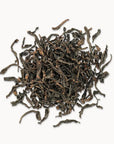

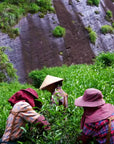

An excellent example of a classic Da Hong Pao Oolong from the Wuyi Mountains(famous for producing “rock” teas). Deep within China’s mist-shrouded Wuyi Mountains—a UNESCO World Heritage site—tea trees grow among ancient volcanic cliffs, nourished by mineral-rich “Danxia” soil and abundant rainfall. This unique landscape gives Wuyi Rock Tea its signature character, known as “Rock Rhyme” (Yan Yun)—a deep, mineral complexity with a lingering floral finish.
Carefully crafted using traditional techniques, the leaves are pan-fired, hand-rolled, and repeatedly baked over charcoal. This slow process develops rich roasted aromas, smooth depth, and the unforgettable character of Da Hong Pao.
Da Hong Pao contains caffeine, theophylline, polyphenols, and flavonoids, all which contribute to supporting overall wellbeing. Research suggests that this tea is excellent at supporting cellular health which has a positive impact on the skin, mind, and body. Anecdotally, many drink Da Hong Pao to support their metabolism.
With its bold yet balanced profile, Da Hong Pao pairs beautifully with rich and spicy dishes, refreshing the palate after a flavorful meal. In China, afternoons are often spent enjoying this tea with friends and family, savoring its unique flavors and the calm ritual it brings.
Top: Bold charcoal roast & ripe stone fruit.
Heart: Delicate orchid florals & soft woody notes.
Base: A crisp, mineral-rich "Rock Rhyme" (Yan Yun) with a honey finish.
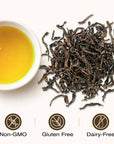
The Experience: A bold charcoal roast with ripe stone fruit upfront, evolving into delicate orchid and soft woody notes, finishing with apricot, light honey, and a velvety, mineral-rich aftertaste. It is the perfect balance of green tea’s floral freshness and black tea’s robust, warming depth.
Among the many legends surrounding Da Hong Pao, the tale of the Scholar's Gratitude is the most widely celebrated. In 1385, a scholar named Ding Xian fell severely ill from sunstroke while traveling to take the imperial exams. He was saved by a monk from Tianxin Temple who administered a special tea as medicine. After winning the top score and becoming the Zhuangyuan (Grand Scholar), he returned to coat the legendary tea trees in his scarlet imperial robes out of gratitude—giving birth to the name "Da Hong Pao" (Big Red Robe). Today, cherished for its incomparable depth and terroir, it is revered worldwide as the "King of Wuyi Rock Tea."